
 ultimate-guide
AI Agentic Workflows for E-commerce 2026
Table of Contents
- What Are AI Agentic Workflows for E-commerce
- Key AI Trends Shaping E-commerce in 2026
- Autonomous Customer Support Agents: Capability and Scale
- How to Integrate AI with CRM for Seamless Workflows
- AI Workflow Automation Tools 2026: Implementation Roadmap
- Real-world Use Cases: Inventory, Pricing, and Lead Qualification
- Agentic Ethics, Bias Mitigation, and Compliance
- Getting Started with Agentic Workflows
Last Updated: August 30, 2026
What Are AI Agentic Workflows for E-commerce
AI agentic workflows for e-commerce 2026 represent a fundamental shift in how online businesses operate. Rather than executing isolated tasks in response to manual triggers, autonomous agents now orchestrate multi-step processes end-to-end, from customer inquiry to order fulfillment, with minimal human intervention. These workflows combine large language models, real-time data access, and decision-making logic to handle complex operations that previously required dedicated staff.
The distinction matters. Traditional automation runs predefined scripts: if condition X, then action Y. Agentic systems reason about context, adapt to variations, and make autonomous decisions within defined guardrails. An autonomous customer support agent doesn't just retrieve a FAQ answer; it understands customer intent, checks inventory and order history, adjusts recommendations based on real-time data, and escalates to human support only when necessary.
At Azmi AI, we've built custom agentic workflows that handle lead qualification, appointment scheduling, customer support, and order management. The difference between our approach and basic chatbot platforms is architectural: we implement genuine autonomous agents with access to your CRM, inventory systems, and payment infrastructure, not isolated chat interfaces.
How Autonomous Agents Differ from Traditional Automation
Traditional automation excels at repetitive, well-defined tasks. Rule-based systems handle customer password resets, order status inquiries, and form submissions efficiently. They're deterministic: the same input always produces the same output.
Autonomous agents operate differently. They maintain context across multiple turns, access live data sources, evaluate trade-offs, and make decisions that require judgment. A customer contacts support about a delayed shipment. An autonomous agent checks the order, reviews shipping carrier status, assesses inventory for replacement stock, and decides whether to offer a refund, reroute the package, or send a replacement, all while considering the customer's purchase history and lifetime value.
The technical difference: traditional automation runs in isolation. Agentic workflows integrate deeply with your operational systems. They read from your CRM, write qualified leads, trigger fulfillment processes, and maintain audit trails. This integration complexity is why implementation matters, and why platform choice affects your success.
Key AI Trends Shaping E-commerce in 2026
Three trends are reshaping how e-commerce businesses deploy artificial intelligence this year. First, conversational commerce has moved beyond novelty to operational necessity. Customers expect to complete transactions through chat, browsing products, asking questions, and checking out without leaving the conversation interface. Platforms that don't support this lose conversion opportunities.
Second, real-time personalization powered by agentic systems now drives measurable revenue impact. Rather than showing the same product recommendations to every visitor, autonomous agents evaluate browsing history, purchase patterns, inventory levels, and margin optimization simultaneously to surface the most relevant and profitable options. This isn't new technology; what's changed is speed and scale.
Third, workflow orchestration across disconnected systems has become the competitive advantage. Most e-commerce teams operate fragmented stacks: separate tools for CRM, email, inventory, customer support, and analytics. Agentic workflows bridge these gaps, creating seamless handoffs between systems. When a lead qualifies, the agent automatically adds them to your CRM, triggers nurture sequences, and alerts your sales team, without manual intervention.
According to Gartner's 2026 AI adoption forecast, organizations implementing agentic workflows report faster decision cycles and reduced operational overhead. The challenge isn't technology availability; it's integration complexity and governance.
Autonomous Customer Support Agents: Capability and Scale
Autonomous customer support agents now handle 60-80% of inbound inquiries without human involvement, but only when properly configured (gartner.com). These agents resolve password resets, process returns, check order status, and answer product questions. They escalate to human agents when they detect confusion, frustration, or requests outside their authority.
The capability threshold is critical. An agent trained only on FAQ content will fail when customers ask questions requiring judgment. An agent with access to your CRM, inventory system, and order history can make real decisions: approve exceptions, offer alternatives, and adjust recommendations based on business rules.

Scale matters differently than traditional support. Adding human agents costs money linearly. Adding agentic capacity costs less after the initial setup, you're paying for infrastructure, not headcount. This changes unit economics for support-heavy businesses. The best implementations don't eliminate human judgment; they redirect it toward exceptions and decisions that require discretion.
How to Integrate AI with CRM for Seamless Workflows
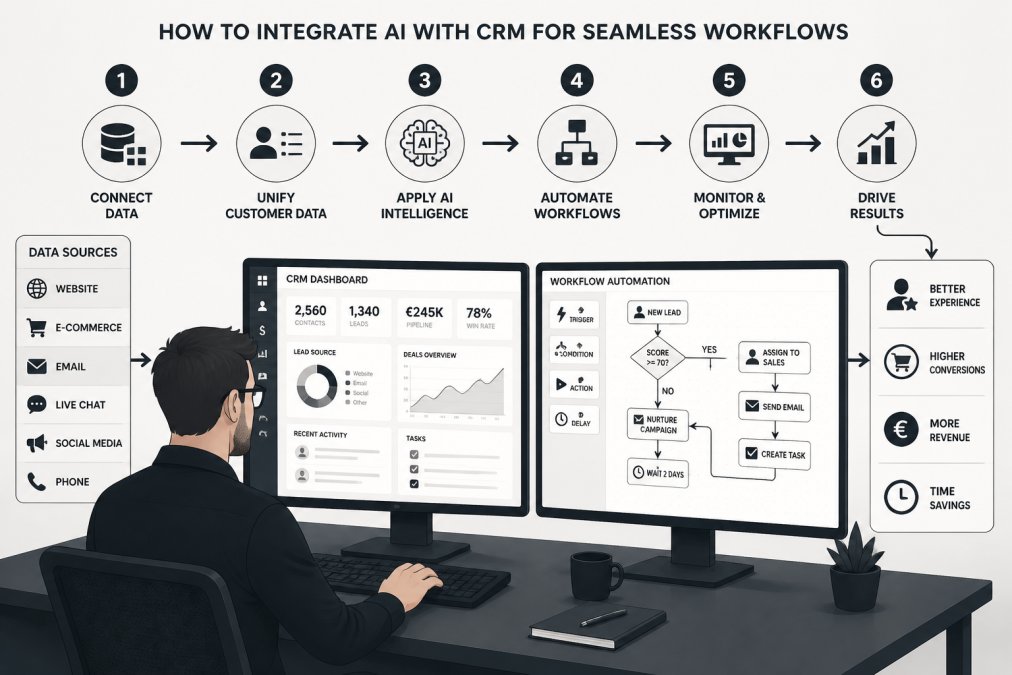
Integrating agentic workflows with your CRM transforms how customer data flows through your business. Rather than support agents manually logging interactions, autonomous agents write structured data directly to your CRM: contact information, interaction history, qualified leads, and conversion signals. Your sales team sees real-time updates without asking.
API Integration and Data Synchronization
CRM integration happens through APIs. Your agentic system needs read access to customer records, order history, and opportunity pipelines. It needs write access to log interactions, create leads, and update deal stages. This requires careful authentication and permission scoping, the agent should only access data necessary for its assigned tasks.
Data synchronization works bidirectionally. When a customer updates their preferences in your CRM, the agent respects those preferences in the next interaction. When the agent qualifies a lead, that information flows back to your CRM immediately, triggering automated workflows, email sequences, sales alerts, or follow-up tasks.
The technical requirement is a stable API with documented authentication (OAuth 2.0 or API keys), rate limits you can handle, and predictable latency. Most enterprise CRMs publish APIs designed for exactly this use case. The implementation work involves mapping your agentic system's data model to your CRM's fields, handling edge cases (what happens when the CRM is unreachable?), and monitoring sync health.
Human-in-the-loop Protocols for Risk Mitigation
Human-in-the-loop (HITL) protocols are your governance layer. They define when the agent acts autonomously and when it pauses for human review. A simple HITL rule: agents can approve refunds under 50 EUR; anything above requires human approval. Another: agents can schedule appointments but must confirm the customer's email before sending the calendar invite.
HITL reduces agent errors and creates accountability. When something goes wrong, a misbooked appointment, an incorrect recommendation, you have a clear record of the decision logic and the option to review it before the customer sees the result. This is critical for regulatory compliance and reputation protection.
The implementation cost is higher than pure automation, but the risk reduction justifies it. Azmi AI builds HITL workflows into every deployment: agents operate with defined authority boundaries, and exceptions escalate to your team for review before execution.
AI Workflow Automation Tools 2026: Implementation Roadmap
Deploying agentic workflows requires a structured approach. The roadmap spans four phases: assessment, design, deployment, and monitoring.
Building Your Agentic Architecture
Phase 1: Assessment (weeks 1-2) involves mapping your current workflows. Which processes consume the most manual effort? Which decisions require judgment versus rule execution? Which systems need to integrate? This phase produces a prioritized list of automation opportunities and a data architecture diagram.
Phase 2: Design (weeks 2-4) specifies the agent's behavior. Define its decision trees, authority boundaries, escalation triggers, and data requirements. Document the integration points with your CRM, inventory, and payment systems. This phase produces a functional specification that guides implementation.
Phase 3: Deployment (weeks 4-8) involves building the agent, integrating systems, and running pilot tests. Start with a small user group, maybe 10% of traffic or a specific customer segment. Monitor error rates, escalation frequency, and customer satisfaction. Adjust decision logic based on real-world performance before expanding.
Phase 4: Monitoring (ongoing) establishes dashboards for agent performance. Track resolution rates, escalation reasons, customer satisfaction, and business metrics (conversion rate, average order value, support cost). Use this data to refine the agent's behavior continuously.
The total timeline from assessment to production typically spans 8-12 weeks for mid-market e-commerce businesses.
Cost-Benefit Analysis for Mid-Market Operations
The cost structure for agentic workflows includes infrastructure (API calls, model inference, hosting), implementation (design and deployment labor), and ongoing maintenance. The benefit side includes reduced support headcount, faster customer response times, and improved conversion rates through better lead qualification and personalization.
For a mid-market e-commerce business handling 500 customer inquiries daily, the payback period is often 4-6 months.
The hidden benefit: speed. Autonomous agents respond instantly; human agents have queue delays. Faster response correlates with higher satisfaction and lower churn, benefits that don't appear in direct cost savings but compound over time.
Real-world Use Cases: Inventory, Pricing, and Lead Qualification
Inventory Management: An autonomous agent monitors stock levels in real-time and adjusts product recommendations based on availability. When a customer asks about a product with low inventory, the agent might recommend a higher-margin alternative or offer pre-order options. This prevents overselling and improves inventory turnover.
Dynamic Pricing: Agentic workflows access market data, competitor pricing, and inventory levels to make real-time pricing decisions. High-demand products with low stock might be priced higher; slow-moving inventory might receive automated discounts. This optimization happens per customer, per session, not through static price lists.
Lead Qualification: An autonomous agent qualifies prospects by asking targeted questions, checking fit against your ideal customer profile, and scoring leads based on explicit criteria. High-scoring leads get routed to sales immediately; low-scoring prospects receive nurture sequences. This reduces sales team friction and improves conversion rates.
Agentic Ethics, Bias Mitigation, and Compliance
Autonomous agents make decisions that affect customers. These decisions must be fair, transparent, and compliant with applicable regulations. Ethics isn't optional; it's foundational to sustainable agentic systems.
Bias Mitigation starts with data. If your training data reflects historical discrimination, for example, if past agents approved refunds more readily for certain customer segments, the new agent will inherit that bias. Mitigation requires auditing training data, testing agent decisions across demographic groups, and adjusting decision logic to ensure equitable treatment.
Transparency means customers understand why the agent made a decision. If an agent denies a refund, the customer should understand the reasoning. If an agent recommends a product, the basis should be clear. This builds trust and reduces escalations.
Compliance varies by jurisdiction. Data protection regulations (like GDPR in the EU) require consent before processing personal data. Consumer protection laws limit agent authority in certain decisions. Financial regulations govern automated lending or payment decisions. Your agentic system must respect these boundaries.
According to EDPB guidance on automated decision-making, organizations deploying autonomous agents must maintain audit trails, offer human review options, and document decision logic. Compliance isn't a feature you add later; it's an architectural requirement.
Getting Started with Agentic Workflows
Starting with agentic workflows doesn't require overhauling your entire operation. Begin with a single, high-impact use case: customer support, lead qualification, or appointment scheduling. Implement a pilot with limited scope, measure results, and expand based on what works.
The first step is assessment. Map your current workflows, identify manual bottlenecks, and define success metrics. What would you measure to know if the agent was working? Faster response time? Reduced support costs? Higher conversion rates? Be specific.
Next, choose your implementation approach. Some businesses build custom agents with Azmi AI's platform. Others use off-the-shelf chatbot builders. The choice depends on integration complexity, customization needs, and budget. Off-the-shelf solutions are faster and cheaper initially but may limit what you can automate. Custom solutions take longer but integrate deeply with your operations.
Azmi AI's implementation process takes approximately one week from assessment to deployment. We design the agent's behavior, integrate it with your CRM and other systems, run pilot tests, and train your team. The result: a custom agentic system that handles your specific workflows and integrates seamlessly with your existing tools.
The competitive advantage accrues to businesses that move quickly. AI agentic workflows for e-commerce 2026 are no longer experimental, they're operational infrastructure. Businesses deploying them now are reducing costs, improving customer experience, and capturing market share. The question isn't whether to implement agentic workflows; it's how quickly you can get started.
Autonomous agents are reshaping e-commerce operations in 2026. The businesses winning are those integrating agentic workflows into customer support, lead qualification, and inventory management. Azmi AI helps you design and deploy custom agentic systems that integrate with your CRM, automate high-impact workflows, and deliver measurable results. Our platform handles the technical complexity, API integration, data synchronization, human-in-the-loop protocols, so your team can focus on strategy. Get started with a free trial and see how agentic workflows can transform your operations.
| Workflow Type | Primary Benefit | Implementation Complexity | Typical ROI Timeline |
|---|---|---|---|
| Customer Support Automation | Reduced support costs | Medium | 4-6 months |
| Lead Qualification | Faster sales cycles | Medium | 3-4 months |
| Appointment Scheduling | Improved calendar efficiency | Low | 2-3 months |
| Inventory Management | Optimized stock levels | High | 6-8 months |
| Dynamic Pricing | Revenue optimization | High | 5-7 months |
Frequently Asked Questions
What is the difference between traditional automation and agentic workflows?
Traditional automation follows fixed rules and scripts, if conditions A and B occur, execute action C. Agentic workflows use autonomous agents that interpret context, make decisions, and adapt in real time. Agents can handle multi-step tasks, respond to unexpected scenarios, and learn from outcomes. For e-commerce, this means customer inquiries get resolved faster because agents understand intent rather than just matching keywords. Agentic systems also handle cross-functional tasks like updating inventory, triggering marketing campaigns, and qualifying leads within a single workflow.
How do autonomous customer support agents actually reduce support team workload?
Autonomous customer support agents handle routine inquiries, order status, returns, product questions, booking requests, without human intervention. Your team focuses only on complex issues that require judgment or empathy. Agents operate 24/7 across time zones, so inquiries get immediate responses instead of queuing. They also qualify leads, capture customer data, and route escalations to the right department. Teams report significant time savings because agents eliminate the repetitive back-and-forth; customers get answers instantly, and your staff handles fewer volume spikes.
How do you integrate AI workflow automation tools with existing CRM systems?
Integration happens through APIs that connect your CRM to the agentic platform. When an agent completes a task, booking an appointment, capturing a lead, processing a return, it automatically syncs back to your CRM in real time. Data governance protocols ensure information flows securely and consistently. You define which fields sync, which triggers fire, and how conflicts resolve. The key is ensuring your CRM schema matches the agent's output format so handoffs are seamless.
What are the top trends in agentic AI for e-commerce in 2026?
Multi-step autonomous workflows are replacing single-function chatbots. Real-time optimization, dynamic pricing, predictive inventory, personalized recommendations, driven by agent decision-making is becoming standard. Conversational commerce where agents guide customers through product discovery and checkout is growing rapidly. Integration with supply chain visibility tools means agents can promise accurate delivery dates. Cross-platform synchronization lets agents handle inquiries from your website, email, and social channels in one unified workflow. Compliance monitoring and bias mitigation are also critical as regulations tighten around automated decision-making.
How do you prevent agentic AI from making costly mistakes like overbooking or mishandling customer data?
Human-in-the-loop protocols are essential. High-risk decisions, refunds above a threshold, appointment slots in peak times, access to sensitive customer data, require human approval before execution. Agents flag these exceptions automatically and route them to your team with full context. Compliance monitoring tracks every decision against your business rules and regulatory requirements. You set guardrails: agents can book appointments only within available slots, approve discounts only up to a limit, and escalate disputes immediately. Testing and fine-tuning happen in staging before agents go live, and audit logs capture every action for liability and improvement.
Can agentic workflows handle multiple languages and time zones effectively?
Yes. Modern agentic platforms support multilingual LLM-driven operations, so agents understand and respond in your customers' languages. They also handle time-zone logic automatically, scheduling agents know local hours, overnight inquiries queue for morning response, and 24/7 availability means no customer waits. The agent understands context like regional holidays, local regulations, and cultural preferences. Workflow orchestration ensures that when an agent hands off to a human team member in another region, all context transfers seamlessly. This is especially valuable for global e-commerce and service firms operating across multiple markets.
What's the ROI timeline for implementing agentic workflows?
Cost-benefit analysis shows ROI typically appears within 3-6 months. Initial gains come from reduced support volume and faster lead qualification, fewer inquiries require human handling, and qualified leads convert faster. Operational efficiency gains include fewer manual data-entry errors, reduced appointment no-shows, and faster order resolution. Revenue growth comes from 24/7 availability capturing sales outside business hours and improved customer experience driving retention. Scaling is cost-efficient because adding agents to handle new channels or languages doesn't require proportional headcount increases.
How do you know if agentic workflows are right for your business?
Agentic workflows deliver the most value if your business handles high-volume repetitive tasks, operates across time zones, or struggles with manual scheduling and lead qualification. E-commerce companies benefit immediately from 24/7 customer support and inventory visibility. Service firms with booking systems gain efficiency from automated appointment scheduling and customer follow-up. B2B lead-gen firms accelerate qualification by automating visitor engagement and demo scheduling. If your team spends more than 20% of time on routine tasks that follow predictable patterns, agentic automation will create capacity. Start with a free trial to test your most time-consuming workflow before full implementation.
This article was written using GrandRanker