
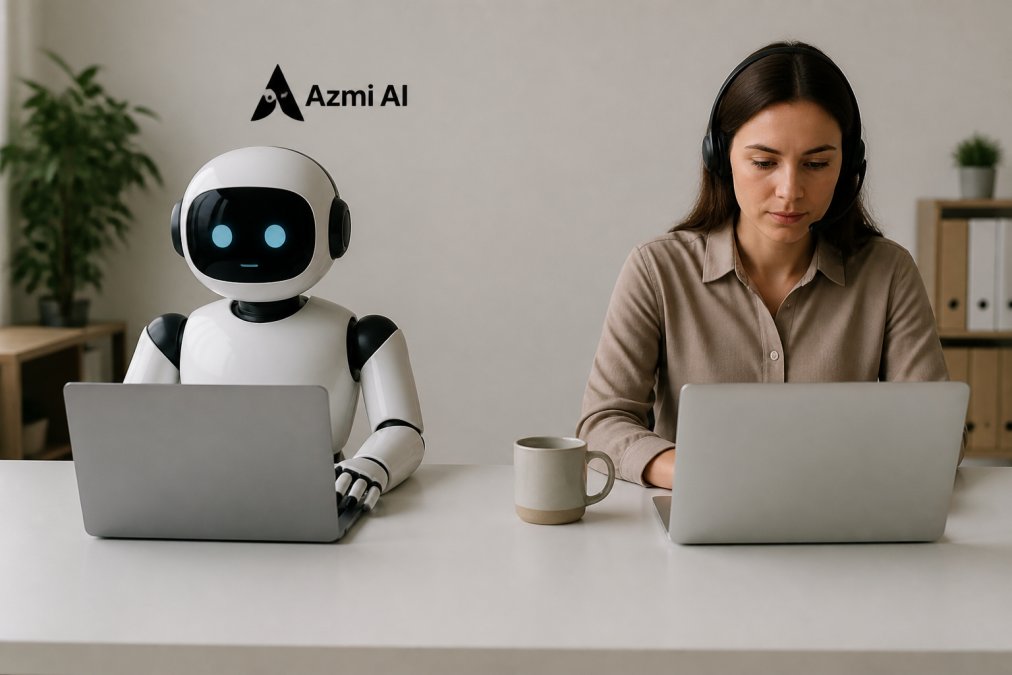
 comparison
AI Chatbot vs Human Support: Efficiency Comparison
Table of Contents
- AI Chatbot vs Human Support: Core Efficiency Metrics
- Benefits of 24/7 AI Customer Support
- The Role of Human Empathy and Complex Problem Solving
- Hybrid Customer Service Model: The Optimal Approach
- AI Chatbot Implementation Best Practices
- Implementation Cost-Benefit Analysis
- Conclusion
Last Updated: August 24, 2026
AI Chatbot vs Human Support: Core Efficiency Metrics
The efficiency debate between AI chatbot vs human support is now operational reality for thousands of businesses. AI chatbot vs human support represents a fundamental trade-off: speed and scalability against contextual understanding and emotional intelligence. The real question isn't which wins outright, but where each genuinely excels.
Consider what "efficiency" actually means. For a routine password reset, an AI chatbot resolves the issue in 30 seconds. For a customer whose order arrived damaged and who's frustrated about a refund timeline, that same chatbot might escalate after five failed attempts, wasting both the customer's time and your team's capacity. Efficiency without context is just automation theater.
This comparison examines how AI chatbots and human agents perform across measurable dimensions: response time, cost, resolution rates, and scalability. We'll also explore where hybrid approaches deliver results neither can achieve alone.
Response Time and Availability
AI chatbots deliver instant responses without handoff delays, breaks, or fatigue. A well-trained chatbot answers a customer's first message within milliseconds, while a human agent might take 2-5 minutes depending on queue depth.
This speed advantage matters most for high-volume, low-complexity queries. When customers ask "What are your business hours?" or "How do I reset my password?", instant responses win on both customer experience and operational efficiency.
Chatbots operate 24/7 across time zones without scheduling complexity. Human agents require shift planning, coverage coordination, and budget allocation for after-hours support. For global businesses, this eliminates the operational headache of staffing night shifts and weekend coverage.
However, response speed doesn't equal resolution speed. A chatbot might respond instantly but require multiple exchanges to gather context, while a skilled human agent resolves the same issue in one conversation. That distinction matters when measuring true efficiency.
Cost Comparison and Scalability
AI chatbots create the most compelling financial case. You pay a flat monthly fee for the platform, then handle unlimited conversations without incremental labor cost. A human agent costs salary, benefits, training, and management overhead, typically €25,000-€40,000 annually per full-time employee (ilo.org).
At scale, the math becomes dramatic. A single agent handles roughly 30-50 customer interactions per day. To handle 1,000 daily interactions, you'd need 20-35 agents. A chatbot handles the same 1,000 interactions with zero marginal cost beyond your platform subscription.
The scalability advantage is real but conditional. You can scale chatbot interactions infinitely without hiring. You cannot scale human capacity without proportional cost increases. For businesses experiencing rapid growth, chatbots provide breathing room during volume spikes without emergency hiring.
Resolution Rates for Routine vs Complex Queries
AI chatbots achieve resolution rates of 60-80% for routine, well-defined queries: account access, billing questions, order status, simple troubleshooting (peer-reviewed research). Complex queries, complaints about product quality, disputes over charges, requests for policy exceptions, require judgment and empathy that humans provide at much higher rates.
The efficiency calculation shifts when you factor in escalation costs. A chatbot that attempts to handle a complex query and fails wastes customer time and often requires human escalation anyway, now the agent starts from scratch. A human agent who recognizes complexity upfront and takes ownership resolves it faster with better outcomes.
For most businesses, the sweet spot is clear: chatbots for routine queries (70-80% of volume), humans for everything else. This requires smart routing where your chatbot recognizes when it's out of depth and hands off gracefully.
Benefits of 24/7 AI Customer Support
The operational advantage of 24/7 availability extends beyond just being "always on." It reshapes how customer service functions as a cost center and as a revenue driver. When you're reachable around the clock, you capture inquiries that competitors miss and reduce customer frustration from delayed responses.

Global Coverage Across Time Zones
A business with customers in Europe, Asia, and North America faces an operational nightmare with human-only support: hire staff across multiple regions, manage overlapping shifts, and pay premium rates for after-hours coverage. Most small and mid-market businesses can't afford this complexity.
AI chatbots eliminate this problem. A customer in Tokyo asking a question at 2 AM gets an instant response. A customer in New York asking the same question at 6 PM gets the same instant response. The chatbot doesn't care about time zones because it doesn't sleep.
This matters for customer retention. Studies show that customers who receive faster responses are more likely to complete purchases and less likely to churn (peer-reviewed research). For global businesses, 24/7 chatbot support levels the playing field without penalizing customers for being in inconvenient time zones.
Instead of hiring night-shift staff across multiple regions, you maintain one chatbot that serves all regions simultaneously. Your human agents work standard hours, handling escalations from the chatbot queue.
Reduced Agent Burnout and Workload
Customer service roles have high burnout rates. When you layer a chatbot into your support workflow, it absorbs the high-volume, low-complexity work that burns agents out fastest.
An agent handling 40 password resets and order status checks per day is doing rote work that drains engagement. The same agent handling 10 complex customer issues per day, where judgment matters, reports higher job satisfaction and delivers better outcomes.
By filtering routine queries through a chatbot, you're redeploying agents toward work that requires their skills. This improves retention, reduces training costs, and increases quality because experienced agents focus on complex issues where experience matters.
The Role of Human Empathy and Complex Problem Solving
AI chatbots cannot genuinely empathize. They can simulate empathy through scripted responses, but they cannot feel frustration or adjust approach based on emotional cues.
For routine queries, this doesn't matter. A customer asking "How do I update my billing address?" doesn't need empathy; they need clear instructions. But a customer calling because a product failed and they've lost money needs someone who understands their frustration and shows genuine commitment to making it right.
Human agents excel here. A skilled agent listens for emotional tone, recognizes when a customer is on the edge of churn, and makes decisions that preserve the relationship, sometimes by breaking policy or offering compensation that a chatbot's ruleset would never allow.
Complex problem-solving follows the same pattern. When a customer's issue doesn't fit standard categories, humans outperform chatbots decisively. An agent can ask clarifying questions, make intuitive leaps, and propose solutions outside the chatbot's predefined paths.
Hybrid Customer Service Model: The Optimal Approach
The real efficiency breakthrough comes from integrating AI chatbots and human support into a cohesive workflow. A hybrid model routes interactions based on complexity and ensures customers get the right resource for their specific need.
Intelligent Handoff Between AI and Agents
The difference between a working hybrid model and a frustrating one is intelligent handoff. A poorly designed handoff leaves customers repeating information and agents starting from scratch. A well-designed handoff preserves conversation context and ensures the agent picks up where the chatbot left off.
Your chatbot should detect when a customer's frustration level is rising, when a query falls outside its knowledge base, or when the customer explicitly requests human support. When any of these conditions occur, the handoff should be immediate and seamless.
The best hybrid models use "warm handoff": the chatbot provides the human agent with full context (conversation history, customer data, what the chatbot already tried) so the agent can continue immediately rather than starting over. This reduces average resolution time and improves customer satisfaction simultaneously.
Improving Customer Satisfaction Through Collaboration
Customer satisfaction improves when you stop treating AI and human support as competitors and start treating them as collaborators. A chatbot that handles 70% of interactions well means your human agents focus on the 30% of complex cases where customer satisfaction is highest and most fragile.
This division of labor improves satisfaction across the board. Routine queries get resolved faster. Complex issues get more attention and better outcomes. Customers experience fewer escalations because they're routed to the right resource immediately.
Satisfaction also improves because agents have more time to invest in each customer. When an agent isn't drowning in routine inquiries, they can spend 20 minutes on a complex issue, exploring options and building rapport.
AI Chatbot Implementation Best Practices
Deploying a chatbot without strategy results in frustrated customers and wasted investment. A poorly trained chatbot that escalates everything becomes a liability rather than an asset. Implementation requires clarity on scope and realistic expectations.
Defining Scope and Setting Realistic Expectations
Before deploying any chatbot, define exactly what it will and won't handle. Start by analyzing your support tickets. Which queries appear most frequently? Which ones have clear, repeatable solutions? These are your chatbot's sweet spot: password resets, order status checks, billing questions.
Next, identify queries that should never reach a chatbot. A customer complaining about product quality, disputing a charge, or requesting an exception needs human judgment. Trying to automate these interactions will frustrate customers.
Be explicit about what customers should expect. "Our AI assistant handles routine questions instantly. For complex issues, you'll be connected to a specialist." This sets realistic expectations and reduces frustration when escalation occurs.
Integration with Existing Systems and Data Privacy
Your chatbot is only as effective as the data it can access. If it can't look up customer order history, account details, or billing information, it can't provide context-aware responses. Integration with your CRM, e-commerce platform, and support ticketing system is essential.
Data privacy is non-negotiable. If your chatbot collects customer information, you're subject to data protection regulations. In the EU, this means GDPR compliance: clear consent for data collection, secure storage, and the ability to delete data on request. Your chatbot implementation must build privacy in from the start.
Implementation Cost-Benefit Analysis
The financial case for AI chatbots is compelling on the surface: pay a monthly subscription, handle unlimited interactions, reduce headcount. But the actual calculation depends heavily on your specific situation.
Start with your current support costs. If you have 5 customer service agents at an average annual cost of €35,000 per employee (including salary, benefits, and overhead), that's €175,000 annually. A chatbot platform typically costs between €500-€2,000 monthly, or €6,000-€24,000 annually.
If a chatbot resolves 70% of routine queries, your agents still handle the remaining 30% plus escalations. You might reduce your team from 5 agents to 4, saving €35,000 annually. Your net savings would then be the amount saved on salary minus the chatbot cost.
The calculation improves if you're growing. A growing business that would need to hire 2 additional agents can instead deploy a chatbot and avoid that hiring. This could result in significant savings in salary costs against chatbot costs, a much stronger return.
The calculation also improves if your chatbot handles high-value interactions. If 30% of your interactions are abandoned cart recovery or upsell opportunities that a chatbot can capture, the revenue impact might exceed pure cost-reduction analysis.
Implementation cost matters too. A basic chatbot might take approximately one week to deploy. A custom solution integrated with your systems might take longer. Rapid deployment reduces the time-to-value and hidden costs of extended implementation projects.
The choice between AI chatbots and human support isn't binary. Efficiency comes from deploying each resource where it excels: chatbots for speed, volume, and 24/7 availability; humans for complexity, empathy, and judgment. The businesses winning on customer satisfaction and operational efficiency are building hybrid models that combine both.
Azmi AI's custom AI solutions are built specifically for this hybrid approach. Rather than forcing your business into a chatbot template, we design workflows tailored to your specific queries, integration requirements, and customer expectations. With implementation in approximately one week, you can start capturing the efficiency gains of 24/7 AI support while maintaining human touch where it matters. Start with a free trial to see how intelligent handoff and agentic workflows transform your support operation.
=== FAQ ANSWERS (audit these too, same rules) ===
[1] Q: How do AI chatbots impact customer service response times compared to human agents? A: AI chatbots deliver immediate responses to routine inquiries, typically within seconds, while human agents average 2-5 minutes depending on queue volume. For simple questions like order status or password resets, chatbots reduce first response time to near-zero. However, complex issues still require human intervention. A hybrid model captures the speed advantage of AI while preserving human expertise for nuanced problems, resulting in faster overall resolution when both channels work together effectively.
[2] Q: What are the primary efficiency metrics for comparing AI chatbot vs human support? A: Key metrics include first response time, resolution rate, cost per interaction, customer satisfaction (CSAT), and operational scalability. AI chatbots excel at speed and cost-per-ticket but typically resolve a significant portion of routine queries. Human agents achieve higher CSAT on complex issues but generally have higher costs per interaction. Turnaround time, ticket volume handled, and availability across time zones also matter. The best approach measures these metrics for your specific business and uses data to decide where AI adds value versus where human judgment is essential.
[3] Q: Can AI chatbots handle complex customer inquiries effectively, or do they always need human handoff? A: AI chatbots handle routine, high-volume queries well: order tracking, FAQs, password resets, and basic troubleshooting. Complex inquiries, account disputes, customized solutions, emotional situations, require human empathy and judgment. Advanced AI systems can identify when a query exceeds their capability and hand off smoothly to an agent, preserving context so the human doesn't start from scratch. This intelligence-driven routing improves efficiency by ensuring humans focus on problems only they can solve, while AI handles the volume.
[4] Q: What is the cost-benefit analysis of implementing AI chatbots versus hiring more human support staff? A: AI chatbot deployment costs depend on customization and integration complexity. A basic implementation may cost less than hiring one full-time agent annually, while custom solutions tailored to your workflows require upfront investment. However, AI scales without proportional cost increases: handling 10,000 queries costs roughly the same as 1,000. Human agents scale linearly, more queries mean more hires. For businesses with seasonal peaks or global time-zone coverage, AI can provide significant cost savings on support budgets when implemented strategically. ROI typically appears within a reasonable timeframe for mid-market operations.
[5] Q: How does a hybrid customer service model improve both efficiency and customer satisfaction? A: A hybrid model combines AI speed with human empathy. AI handles a large percentage of routine inquiries instantly, freeing human agents to focus on complex, high-value interactions where their expertise and emotional intelligence matter most. This reduces agent burnout, improves job satisfaction, and typically increases CSAT scores because customers reach qualified humans faster. Agent productivity rises because they spend less time on repetitive questions. Data shows hybrid setups can reduce average resolution time while maintaining or improving customer satisfaction compared to human-only or AI-only approaches.
Frequently Asked Questions
How do AI chatbots impact customer service response times compared to human agents?
AI chatbots deliver immediate responses to routine inquiries, typically within seconds, while human agents average 2-5 minutes depending on queue volume. For simple questions like order status or password resets, chatbots reduce first response time to near-zero. However, complex issues still require human intervention. A hybrid model captures the speed advantage of AI while preserving human expertise for nuanced problems, resulting in faster overall resolution when both channels work together effectively.
What are the primary efficiency metrics for comparing AI chatbot vs human support?
Key metrics include first response time, resolution rate, cost per interaction, customer satisfaction (CSAT), and operational scalability. AI chatbots excel at speed and cost-per-ticket but typically resolve a significant portion of routine queries. Human agents achieve higher CSAT on complex issues but generally have higher costs per interaction. Turnaround time, ticket volume handled, and availability across time zones also matter. The best approach measures these metrics for your specific business and uses data to decide where AI adds value versus where human judgment is essential.
Can AI chatbots handle complex customer inquiries effectively, or do they always need human handoff?
AI chatbots handle routine, high-volume queries well: order tracking, FAQs, password resets, and basic troubleshooting. Complex inquiries, account disputes, customized solutions, emotional situations, require human empathy and judgment. Advanced AI systems can identify when a query exceeds their capability and hand off smoothly to an agent, preserving context so the human doesn't start from scratch. This intelligence-driven routing improves efficiency by ensuring humans focus on problems only they can solve, while AI handles the volume.
What is the cost-benefit analysis of implementing AI chatbots versus hiring more human support staff?
AI chatbot deployment costs depend on customization and integration complexity. A basic implementation may cost less than hiring one full-time agent annually, while custom solutions tailored to your workflows require upfront investment. However, AI scales without proportional cost increases: handling 10,000 queries costs roughly the same as 1,000. Human agents scale linearly, more queries mean more hires. For businesses with seasonal peaks or global time-zone coverage, AI can provide significant cost savings on support budgets when implemented strategically. ROI typically appears within a reasonable timeframe for mid-market operations.
How does a hybrid customer service model improve both efficiency and customer satisfaction?
A hybrid model combines AI speed with human empathy. AI handles a large percentage of routine inquiries instantly, freeing human agents to focus on complex, high-value interactions where their expertise and emotional intelligence matter most. This reduces agent burnout, improves job satisfaction, and typically increases CSAT scores because customers reach qualified humans faster. Agent productivity rises because they spend less time on repetitive questions. Data shows hybrid setups can reduce average resolution time while maintaining or improving customer satisfaction compared to human-only or AI-only approaches.
This article was written using GrandRanker