 blog
blog
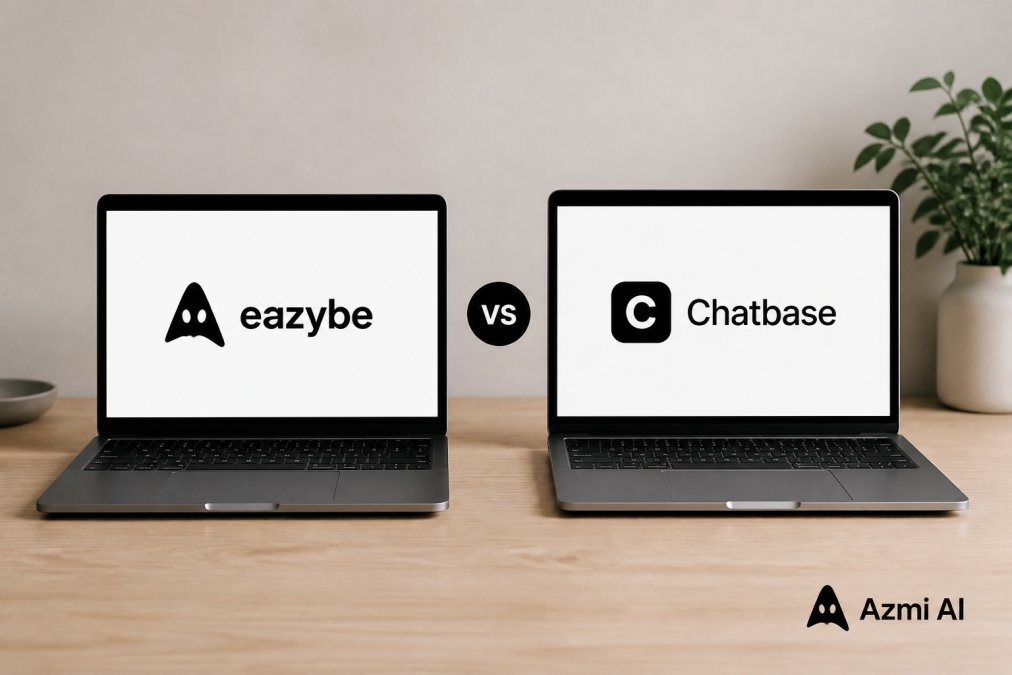
Eazybe vs Chatbase for Customer Support
Table of Contents
- Eazybe vs Chatbase: Feature and Pricing Comparison
- How Each Platform Handles Customer Support Workflows
- AI Chatbot Implementation Best Practices for Both Tools
- Custom AI Agent Benefits for Small Business Operations
- Integrating AI Agents Into Customer Support Workflows
- Data Privacy, Compliance, and Security Considerations
- Which Platform Should You Choose?
- Frequently Asked Questions
Last Updated: September 2, 2026

Eazybe vs Chatbase: Feature and Pricing Comparison
Eazybe vs Chatbase for customer support represents two distinct approaches to automating conversations. Eazybe focuses on straightforward chatbot deployment with minimal setup friction. Chatbase emphasizes knowledge base training and semantic understanding. The choice hinges on whether you need rapid deployment or deeper customization.
Eazybe claims roughly one-week implementation. Chatbase requires more upfront work training the knowledge base but offers finer control over response accuracy. Neither platform is inherently "better", the right choice depends on your team size, query complexity, and tolerance for configuration work.

How Each Platform Handles Customer Support Workflows
Eazybe routes inquiries through pre-built conversation flows. You define common questions, map them to answers, and the system serves responses when matching queries arrive. Escalation to human agents happens when the chatbot confidence drops below a threshold you set.
Chatbase ingests your documentation, FAQs, and help articles as unstructured data, using semantic matching to find relevant content and generate responses based on that material. If your documentation is comprehensive and well-organized, Chatbase handles more nuanced questions because it reasons from actual company knowledge rather than pre-written scripts.
A customer asking something slightly different from your templated questions may cause Eazybe to escalate immediately, while Chatbase attempts to synthesize an answer from related content. This works well if your knowledge base is current; it fails if documentation is outdated or incomplete.
For multi-channel support, both platforms integrate with common helpdesk systems. Chatbase's API is more developer-friendly for custom integrations. Eazybe prioritizes the visual builder, making it accessible to non-technical support managers.
Human handoff differs too. Eazybe hands off with full conversation history and confidence scores. Chatbase includes the bot's reasoning and source documents, helping agents understand what information the AI was working from.
AI Chatbot Implementation Best Practices for Both Tools
Implementation success hinges on realistic timelines and ongoing maintenance. Most platform claims assume your knowledge base is clean, your team is available for testing, and integrations are straightforward.
Time-to-Value Reality
Eazybe's one-week deployment is achievable for 10-15 high-volume, straightforward questions with pre-written answers. However, "live" doesn't mean "effective." True stability, where the bot handles 60-70% of inquiries without escalation, typically takes 4-6 weeks of iteration (peer-reviewed research).
Chatbase requires more upfront work. Knowledge base ingestion and semantic tuning take 2-3 weeks before launch. Once live, Chatbase often performs better on nuanced questions, but only if your knowledge base is current and well-structured.
A realistic timeline for either platform:
- Week 1-2: Knowledge base audit, conversation design, integration setup
- Week 3-4: Internal testing, bug fixes, team training
- Week 5-6: Limited live launch (single channel, monitored closely)
- Week 7-12: Iteration based on real conversations, escalation analysis, refinement
Post-Deployment Maintenance Burden
A chatbot requires ongoing maintenance to remain accurate. For Eazybe, maintenance means reviewing escalations weekly and updating conversation flows based on what the bot missed. As your product evolves, flows become outdated. A feature change, pricing update, or policy shift requires manual updates.
For Chatbase, maintenance centers on knowledge base freshness. Every documentation change affects bot responses. If your knowledge base includes deprecated information, the bot confidently gives outdated advice. Audit your knowledge base monthly, remove old articles, flag contradictions, and update pricing and process documentation immediately.
A practical maintenance schedule:
- Weekly: Review escalations and failed conversations.
- Bi-weekly: Update flows (Eazybe) or knowledge base (Chatbase).
- Monthly: Audit for outdated information and gaps.
- Quarterly: Assess bot performance metrics and plan improvements.
For a small team, this maintenance typically requires 3-5 hours per week (peer-reviewed research). Neglecting maintenance is the most common reason chatbot projects fail within six months.
Knowledge Base Decay and Accuracy Drift
Chatbase users face knowledge base decay: as your product evolves, documentation lags. The bot, trained on outdated documentation, confidently gives wrong answers. Implement a documentation governance process. Assign ownership of each help article to a specific team member and require quarterly reviews. Remove articles older than 12 months unless actively maintained (peer-reviewed research).
Eazybe avoids this problem because you write responses directly, but your team bears the burden of keeping those responses accurate.
Start Small and Iterate
Identify your highest-volume support queries (10-15 questions consuming the most agent time), build automation for those first, then expand. A bot that handles 50% of inquiries perfectly is more valuable than one attempting 100% and succeeding 40% of the time.
Monitor sentiment in escalations and track resolution time. If escalations take longer because the bot gave incomplete information, refine your bot before expanding its scope. Treat implementation as a 12-week project, not a one-week launch.
Custom AI Agent Benefits for Small Business Operations
Custom AI agents take actions, not just answer questions. An AI agent for service businesses might automatically check appointment availability, confirm bookings, and update scheduling systems. For e-commerce, an agent could check inventory, apply discounts, and initiate refunds without human intervention.
Eazybe and Chatbase excel at answering questions. Custom agents execute transactions. For a three-person service firm drowning in booking requests, an agent handling 70% of appointments without human touch is transformative.
The trade-off is complexity. Custom agents require API integrations and business logic configuration. But if your support bottleneck is "processing requests" rather than "answering questions," a basic chatbot won't move the needle.
Azmi AI builds custom agents for this use case. Rather than forcing workflows into a chatbot interface, we design agents matching your actual processes. Implementation takes roughly one week. For small teams, this often means the difference between scaling support and hiring another person.
Cost structures differ too. Chatbot platforms charge per conversation or contact. Custom agents often use project-based or usage-based models. For low-volume support (under 100 conversations daily), a chatbot is cost-effective. For high-volume operations, custom agents become economical because you're automating actual transactions.
Integrating AI Agents Into Customer Support Workflows
Integration determines whether an AI system becomes part of your operation or sits isolated. Your team needs the AI system to feed data back into your CRM, ticketing system, and analytics platform.
Eazybe integrates with Zendesk, Intercom, and Freshdesk through pre-built connectors. If you're using those platforms, setup is straightforward. Chatbase's API-first approach makes custom integrations easier for developers.
Every conversation the AI handles should create a record in your support system. Escalations should appear in your agent queue with full context. Without these connections, you're running a separate system, not integrating one.
Real-time analytics are essential. You need to see what percentage of conversations the AI resolves without escalation, average resolution time, customer satisfaction scores, and trending topics. Eazybe's reporting is more visual; Chatbase's is more technical.
Handoff quality determines customer satisfaction. When an escalation reaches your team, they should have full conversation history, the bot's confidence level, what it tried, and why it failed. Eazybe handles this well. Chatbase requires more configuration to achieve the same result.
Data Privacy, Compliance, and Security Considerations
For any customer support system handling customer data, security and compliance are non-negotiable. Your customers' support conversations often contain sensitive information: account numbers, payment details, and personal preferences. A breach exposes your customers and creates legal liability.
Both Eazybe and Chatbase process customer data on their infrastructure. You need to understand where that data lives, how long it's retained, who can access it, and what protections are in place.
Data Residency and Jurisdiction
If your business operates under data protection regulations, you may have legal obligations around where customer data can be stored. Ask each vendor directly:
- Where are customer conversations stored (which data centers, which regions)?
- Can you request data residency within a specific country or region?
- If data is stored outside your jurisdiction, what legal agreements govern that transfer?
- Do they offer data processing agreements (DPAs) that comply with your local regulations?
If a vendor cannot guarantee data residency in your region and your compliance requirements demand it, that vendor is disqualified.
Encryption and Key Management
Encryption in transit and at rest should be standard. Verify:
- Encryption standard: Is it AES-256 (industry standard)?
- Key management: Who holds the encryption keys? Customer-managed keys are more secure but more operationally complex.
- TLS/SSL for data in transit: Conversations should use TLS 1.2 or higher.
Request the vendor's security documentation or SOC 2 Type II report, which details their encryption practices.
Access Controls and Role-Based Permissions
Your support team shouldn't all have access to all conversations. Role-based access control (RBAC) lets you define who can view what. Both platforms offer RBAC, but granularity varies. Ask:
- Can you restrict access by conversation type?
- Can you set read-only vs. read-write permissions?
- Can you audit who accessed which conversations and when?
- Can you revoke access immediately when someone leaves your team?
Audit Logs and Compliance Monitoring
Audit logs are records of who accessed what, when, and from where. Verify:
- Are audit logs retained for at least 12 months?
- Can you export audit logs for compliance reviews?
- Do logs include IP addresses, timestamps, and the specific data accessed?
- Can you set alerts for suspicious activity?
Data Retention and Deletion
Define how long each platform keeps conversation data after you delete it. Ask:
- What is your data retention policy for deleted conversations?
- Can we request immediate deletion of specific conversations?
- Do you use customer data to train your AI models? If so, can we opt out?
- If we delete our account, how long until all our data is purged?
Third-Party Integrations and Data Sharing
When you connect your support system to your CRM or payment processor, customer data flows between systems. Verify:
- Does the integration use secure authentication (OAuth 2.0 or API keys)?
- Is data in transit encrypted?
- Does the third-party tool have its own security certifications (SOC 2, ISO 27001)?
- Can you audit what data is being shared with each integration?
- Can you revoke an integration's access immediately?
Compliance Certifications and Standards
Common certifications include:
- SOC 2 Type II: Audits security, availability, and confidentiality controls. This is the most common requirement for enterprise software.
- ISO 27001: International standard for information security management.
- PCI DSS (if handling payment card data): Required for vendors processing credit card information.
For most businesses, SOC 2 Type II is the baseline requirement. If a vendor doesn't have it, that's a red flag.
Practical Verification Checklist
Before committing, send each vendor a security questionnaire covering data residency, encryption standards, role-based access control, audit log retention, data retention policies, third-party integration security, compliance certifications, data processing agreements, incident response procedures, and right to audit.
Document their responses in writing. If a vendor is evasive or refuses to answer, look elsewhere. For regulated industries, security and compliance should be weighted as heavily as features.
Which Platform Should You Choose?
Eazybe wins if you need rapid deployment and your support queries are straightforward. Setup is fast, the interface is intuitive, and you'll see results within weeks. Choose Eazybe if your team is non-technical and you want to minimize configuration work.
Chatbase wins if you have comprehensive documentation and want deeper semantic understanding of customer questions. It handles nuance better, but requires more upfront investment in knowledge base preparation. Choose Chatbase if your queries are complex and your documentation is current.
Neither platform is the answer if your bottleneck is processing transactions rather than answering questions. If customers need bookings confirmed, refunds initiated, or status updates retrieved from your system, a chatbot alone won't solve your problem.
Azmi AI builds custom agents designed around your actual processes. Implementation takes roughly one week, and the system is tailored to your specific needs. For operations managers tired of evaluating generic platforms, custom agents often deliver better results at comparable cost.
The choice between Eazybe and Chatbase is valid if your use case fits their design. But if your support problem requires more than answering questions, the right tool is often a custom agent built for your specific workflows.
Frequently Asked Questions
What are the primary differences between Eazybe and Chatbase for customer support?
Eazybe and Chatbase differ in deployment approach, customization depth, and integration scope. Chatbase focuses on quick setup for basic chatbot functionality, while platforms offering custom AI agent solutions provide deeper workflow automation, multi-channel deployment, and agentic capabilities tailored to specific business processes. Your choice depends on whether you need out-of-the-box simplicity or sophisticated automation that handles complex customer support scenarios across multiple channels.
How do I integrate AI agents into existing CRM and booking systems?
Most modern customer support AI tools offer API integration and pre-built connectors for common CRM platforms. When evaluating solutions, check for native integrations with your specific tools, API documentation for custom workflows, and support for automated data synchronization. Implementation typically involves mapping customer data fields, configuring escalation rules to your CRM, and testing handoff workflows. Ask vendors about integration time-to-value and post-deployment support to ensure smooth adoption.
Are there data privacy considerations for AI support tools under GDPR?
Yes. Any AI customer support platform handling personal data must comply with GDPR requirements, including data processing agreements, user consent for data collection, and the right to data deletion. Before selecting a tool, verify the vendor's data residency options, encryption standards, and SOC2 certification. Request their Data Processing Agreement (DPA) and clarify where customer conversations are stored and processed. This is especially important if you handle inquiries from users in EU jurisdictions.
What implementation time-to-value should I expect from these platforms?
Chatbase typically deploys in days with minimal configuration, ideal for quick proof-of-concept. Custom AI agent solutions may take 1-2 weeks for full implementation, including strategy planning, knowledge base training, workflow design, and team onboarding. Time-to-value depends on data readiness, integration complexity, and your team's availability for testing. Platforms offering faster deployment often trade customization depth; solutions requiring more setup time typically deliver higher automation and fewer manual interventions once live.
Ready to move beyond chatbot conversations to actual workflow automation? Azmi AI builds custom AI solutions that integrate with your existing systems and handle the specific tasks your team does manually today. Get started with a free trial and see how AI agents can reduce your support workload while improving customer experience across all time zones.
This article was written using GrandRanker